






Spinal Cord Injury Update
Spring 2005: Volume 14, Number 2
Literature Review
The articles previewed below were selected from a recent screening of the National Library of Medicine database for articles on spinal cord injury. In the judgment of the editors, they include potentially useful information on the diagnosis or management of spinal cord injury. You may obtain copies of the complete articles through your local medical library or from UW Health Sciences Library Document Delivery Service (call 206-543-3436 for fee schedule).
Contents:
Assistive Technology | Complications | Pediatric SCI | Psychosocial | Other
Assistive Technology:
-
Effect of a pushrim-activated power-assist wheelchair on the functional capabilities of persons with tetraplegia.
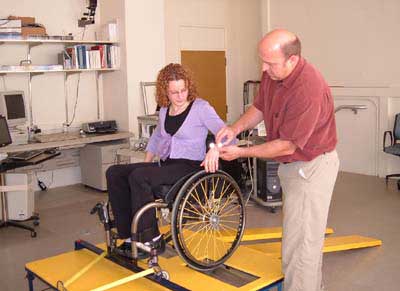
Fifteen full-time manual wheelchair users with tetraplegia participated in trials that involved propelling both their own manual wheelchairs and a pushrim-activated power-assisted wheelchair (PAPAW) three times each (six trials total) over an ADL-simulation course with 18 obstacles. Each participant's heart rate was monitored throughout testing, and participants were surveyed with a visual analog scale to determine the ease of completing each obstacle and their ergonomic preferences between the two wheelchairs. Four obstacles (carpet, dimple strips, up a ramp, up a curb cut) were rated as being significantly easier to complete when using the PAPAW. There was a significant decrease in mean heart rate in all trials with the PAPAW. Amount of assistance needed, responses to ergonomic questions, and overall time to complete course did not differ significantly between the two wheelchairs. For subjects with tetraplegia, PAPAWs have the potential to improve functional capabilities, especially when propelling up ramps, over uneven surfaces, and over thick carpet.
Algood SD, Cooper RA, Fitzgerald SG, et al.
Arch Phys Med Rehabil. 2005 Mar;86(3):380-6.
-
Demographic and socioeconomic factors associated with disparity in wheelchair customizability among people with traumatic spinal cord injury.
Assistive technology information on 412 people with SCI who use wheelchairs more than 40 hours a week was collected by 13 Model SCI Systems via interviews. Information included age, race, education, level of injury, and wheelchair funding source. Ninety-seven percent of manual wheelchair users and 54% of power wheelchair users had customizable wheelchairs. No power wheelchair user received a wheelchair without programmable controls. Minorities with low socioeconomic backgrounds (low income, Medicaid/Medicare recipients, less educated) were more likely to receive standard wheelchairs than the more appropriate customizable wheelchairs. This survey found that the standard of care for manual wheelchair users with SCI is a lightweight and customizable wheelchair; for power wheelchairs users, programmable controls and customizable features are recommended. Unfortunately, socioeconomically disadvantaged people were less likely to receive customizable wheelchairs.
Hunt PC, Boninger ML, Cooper RA, et al.
Arch Phys Med Rehabil. 2004 Nov;85(11):1859-64.
Complications:
-
Microbiology of the urethra and perineum and its relationship to bacteriuria in community-residing men with spinal cord injury.
To understand the relationship between bacterial colonization of the urethra and perineum and bacteriuria, cultures of the urine, urethra, and perineum were obtained from 70 men with SCI. Urine colony count was 0 in 16 (22.9%) men, and 54 (77.1%) men were culture-positive for various uropathogens. In 40 (74.1%) men with bacteriuria, at least one bacterial species present in the urine was also found in the urethra and/or perineum. Differences in the occurrence of uropathogens in men with and without bacteriuria were statistically significant, and organisms were present in higher numbers in men with bacteriuria. Men with SCI who have bacteriuria are significantly more likely to be colonized in the distal urethra and perineum with uropathogens that are often present in the urine in comparison with men without bacteriuria. Additional studies are necessary to determine why some persons with SCI are able to re-establish normal skin flora.
Waites KB, Canupp KC, DeVivo MJ.
J Spinal Cord Med. 2004;27(5):448-52. -
Exacerbation of chronic pain following spinal cord injury.
Of 120 persons with SCI and chronic pain who completed a postal survey, over 50% indicated that prolonged sitting, infections, fatigue, muscle spasms, cold weather, and sudden movements exacerbated their pain. Five sets of factors were found to magnify pain: negative mood, prolonged afferent activity (bowel, bladder, somatic), weather, voluntary physical activity, and transient somatic afferent activity (muscle spasms, sudden movements, touch). A combination of decreased activity levels due to pain, pain located in the frontal aspects of torso (including genitals), "burning" or "electric" pain, and a limited perception of life control was significantly associated with a high extent of pain aggravation. People who suffer from these difficult pain syndromes can benefit from knowledge about factors that may amplify pain.
Widerstrom-Noga EG, Turk DC.
J Neurotrauma. 2004 Oct;21(10):1384-95.
Pediatric SCI:
-
Effect of bracing on paralytic scoliosis secondary to spinal cord injury.
A review of patient records from 1996-2001 at a Shriners Children's Hospital found 125 patients who sustained SCI prior to skeletal maturity. At final follow-up (average 7.7 years after injury), 117 (95%) developed scoliosis. Forty-two patients presented with a curve <10°, 29 of whom were braced, and 13 who were not. Of the braced group, 13 (45%) went on to surgery, compared to 10 (77%) of the nonbraced group. Average time to surgery was 8.5 years for patients who were initially braced and 4.2 years for those who were not braced. A similar trend was seen in the patients who presented with an initial curve between 11° and 20°. There was no significant difference between time to surgery for the braced and nonbraced patient groups at higher (>20°) initial curve presentations. Bracing of children with SCI before significant curve formation (< 20°) delays the time to surgical correction of the deformity as it progresses. At smaller curves (< 10°), bracing may even prevent the need for surgery. As curve size increases ( >20°), bracing seems to play a limited role.
Mehta S, Betz RR, Mulcahey MJ, et al.
J Spinal Cord Med. 2004;27 Suppl 1:S88-92. - A survey of chronic pain in the pediatric spinal cord injury population.
To assess the incidence and type of chronic pain in the pediatric SCI population and to evaluate the resulting impact on activities of daily living (ADLs), 31 patients with pediatric-onset SCI were evaluated using standardized assessments of pain and function (Adolescent Pediatric Pain Tool and the Lansky Play Performance Scale), as well as a questionnaire about types of pain. Twenty (65%) reported chronic pain, classified as either nociceptive (48%) or neuropathic (19%). Interference with ADLs and play was present in only one participant. Nociceptive pain (either visceral or musculoskeletal) was more common than neuropathic pain. These data suggest that although common, chronic pain associated with childhood SCI has a significantly smaller impact on daily activities than that reported in the literature for adult-onset SCI.
Jan FK, Wilson PE.
J Spinal Cord Med. 2004;27 Suppl 1:S50-3.
Psychosocial:
- Patterns of alcohol and substance use and abuse in persons with spinal cord injury: risk factors and correlates.
This was a retrospective cross-sectional study using Model SCI System research data on 3,041 participants (age 18 and older) who were injured between 1975-2002 and interviewed between November 2000 and March 2003. Using several measures of alcohol consumption, substance use, life satisfaction, and pain, data showed that 14% of the subjects were classified as likely to have an alcohol abuse issue and 11% reported using illegal drugs or prescription medications for non-medical reasons. At-risk drinkers and substance users tended to be younger, single, male, and less educated. Subjects with alcohol dependency problems and substance users reported more pain and lower satisfaction with life. Persons who drank without indication of problem drinking had better occupation outcomes than abusers or abstainers. Pressure ulcers were associated with substance use.
Tate DG, Forchheimer MB, Krause JS, et al.
Arch Phys Med Rehabil. 2004 Nov;85(11):1837-47.
- Symptoms of major depression in people with spinal cord injury: implications for screening.
This cross-sectional study was based on data collected during the one-year follow-up assessment of 849 persons from 16 Model SCI Systems, using the Patient Health Questionnaire-9 (PHQ-9), a measure of major depressive disorder (MDD). Exactly 11.4% of participants met criteria for probable MDD, which was associated with poorer subjective health, lower satisfaction with life, and more difficulty in daily role functioning. Probable MDD was not related to most demographic or injury-related variables. Both somatic and psychologic symptoms predicted probable MDD. The authors conclude that the PHQ-9 has promise as a tool with which to identify probable MDD in people with SCI. Somatic symptoms should be counted toward the diagnosis and should alert health care providers to the likelihood of MDD. More efficient screening is only one of the quality improvement efforts needed to enhance management of MDD.
Bombardier CH, Richards JS, Krause JS, et al.
Arch Phys Med Rehabil. 2004 Nov;85(11):1749-56.
Other:
-
Targeting recovery: priorities of the spinal cord-injured population.
A total of 681 persons with SCI (51% with tetraplegia) completed a survey on areas of functional recovery that are most important to the SCI population and ranked seven functions in order of importance to their quality of life. Regaining arm and hand function was most important to persons with tetraplegia, while regaining sexual function was the highest priority for those with paraplegia. Regaining walking movement was the highest priority only to 7.8% of subjects with tetraplegia and 15.9% of those with paraplegia. Most participants indicated that exercise was important to functional recovery, yet more than half could not exercise due to lack of access to facilities. Understanding the priorities of the SCI population is necessary in order to improve the relevance of research in this area.
Anderson KD.
J Neurotrauma. 2004 Oct;21(10):1371-83. -
A demographic profile of new traumatic spinal cord injuries: change and stability over 30 years.
Demographic and injury severity data were collected on 30,532 persons admitted to Model SCI System facilities within one year of injury between 1973 and 2003. Over time, the male/female ratio remained fairly stable at 4:1, but the percentage of women increased slightly, especially from motor vehicle collisions (MVCs). The mean age at injury increased significantly from 28.9 years in the 1970s to 38 years in 2000-03. The majority of cases occurred in whites (66.1%), but that percentage is declining, paralleling the changing composition of the U.S. population. Tetraplegia (54.1%) and complete injuries (55.6%) occurred more than paraplegia and incomplete injuries, respectively. MVCs (45.6%) remained the most common etiology. Falls (19.6%) held the second position over violence (17.8%), except for the 1990-1999 period when the positions were reversed. There were significant increases in percentages of new injuries due to automobile, motorcycle, bicycle, and all-terrain vehicle crashes; blunt object attacks; snow skiing; and medical and surgical mishaps. There has been a significant increase in the percentage of ventilator dependent cases, from 2.3% in the 1970s to 6.8% in 2000-03. Demographic and injury trends should be carefully considered in planning for future prevention programs and rehabilitation services.
Jackson AB, Dijkers M, Devivo MJ, et al.
Arch Phys Med Rehabil. 2004 Nov;85(11):1740-8. - Aging with a spinal cord injury: factors associated with the need for more help with activities of daily living.
In an international, cross-secti onal survey of 352 persons with SCI for more than 20 years who had been younger than age 55 at the time of injury, 32.1% reported increased need for help with activities of daily living (ADLs) during the last 3 years. At least one medical complication was reported by 85%. Constipation (47.9%), diarrhea/bowel accidents (41.8%), and pressure ulcers (38.7%) were common. Constipation and pressure ulcers were associated with a 97% and a 76% increase, respectively, in the likelihood of needing more help with ADLs. Female gender was associated with a 96% increased odds of needing more help. There was a 42% increased odds of needing more help with ADLs per decade after SCI. People aging with SCI are vulnerable to medical complications that may result in an increased need for additional assistance with ADLs.
Liem NR, McColl MA, King W, Smith KM.
Arch Phys Med Rehabil. 2004 Oct;85(10):1567-77.