
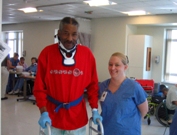






Preparedness basics:
- Create a personal support network of people who will help you in an emergency. Include at least three people at each location where you regularly spend time (home, work, school).
- Make a family and support group communication plan.
- Complete a detailed personal assessment of your capabilities, limitations and assistance requirements.
- Compile a portable, accessible disaster kit that includes a minimum three-day supply of food and water and a two-week supply of medications, personal and medical supplies, and anything related to your disability.
- Prepare an emergency kit for your service animal or pet.
Emergency preparedness resources
With images of Hurricane Katrina fresh in our minds, this is a good time to make a personal disaster plan. Here are some resources that address the unique concerns of people with disabilities:
Prepare.org, an American Red Cross Web site to help the public prepare for natural and human-caused disasters, with a special emphasis on vulnerable populations. Go to: www.prepare.org .
- Disaster Preparedness for People with Disabilities is a step-by-step guide to getting ready and gathering supplies. Read or download the 48-page booklet at www.prepare.org/disabilities/disabilitiesprep.htm , or call your local Red Cross chapter (below) for a copy.
American Red Cross .
- National headquarters, 2025 E Street, NW, Washington, DC 20006;
202-303-4498; www.redcross.org . - King and Kitsap Counties office: 206-323-2345.
- Find a local chapter: www.redcross.org/where/chapts.asp .
City of Seattle Emergency Management, helpful information about preparing for and responding to disasters for Seattle residents. 206-233-5076; sem@seattle.gov ; www.cityofseattle.net/emergency_mgt/ .
READYAmerica , U.S. Department of Homeland Security, has information about preparing for all kinds of disasters and publishes a 16-page booklet Preparing Makes Sense: Get Ready Now . Call 800-237-3239 or download from www.ready.gov .
U.S. Department of Transportation ( www.dot.gov )
- Emergency Preparedness and Individuals with Disabilities at http://www.dotcr.ost.dot.gov/asp/emergencyprep.asp contains basic information on transportation and evacuation for certain modes of transportation, such as transit and rail systems, for individuals with disabilities.
- Contact: Departmental Office of Civil Rights
U.S. Department of Transportation
400 7th Street, S.W.
Washington D.C. 20590
202-366-4648