






SCI Forum Reports
Peer Support Meeting
January 5, 1999
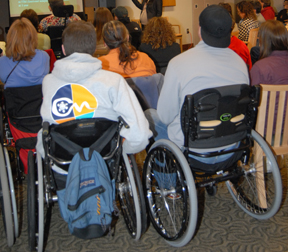
A large group of SCI consumers filled the hospital conference room for an informal evening devoted to sharing personal experiences, information, and advice on a wide range of topics, from getting a job to finding accessible recreation opportunities. At the front of the room sat seven panelists, who collectively represented more than 70 years of combined experience living with SCI.
A question about travel sparked lively discussion about accessibility and affordability. Since the word "accessible" means different things to different people, everyone agreed that it's necessary to be as specific as possible about your needs when booking hotel rooms or transportation. Sigrid, who has C5-6 tetraplegia, said she gets good results when she talks directly to the concierge or manager at a hotel rather than to someone in a reservations office who may not know the width of the doorways or the size of the bathrooms. In some hotels, an accessible room may mean only that it is on the ground floor.
When booking transportation to and from the airport, it's important to be specific about what kind of van you need and whether you need assistance with your wheelchair. For affordable travel ideas, panelists suggested checking advertisements in Sports 'n' Spokes (published by the Paralyzed Veterans of America), New Mobility, and other disability magazines.
After SCI, people often wonder how they will be able to finish their education or get a job. "I was a sophomore at the UW (University of Washington) when I was hurt," said Cas, who has a T4 complete injury. "Going back to school was a slow progression. Chances are you'll be fighting other battles too, such as bowel and bladder problems, so don't go full speed into classes."
All schools have disabled student services offices, which can help students obtain disability accommodations such as accessible classrooms and transportation, and note-takers.
Jacquie, who has T2 complete paraplegia, was injured 21 years ago at the age of six. Now a first grade teacher, she had her college tuition and books paid by the Washington State Division of Vocational Rehabilitation (DVR) and her living expenses covered by federal Supplemental Security Insurance (SSI). DVR will often pay for computers for disabled students, she said.
Unfortunately, working and bringing home a paycheck after injury may result in a loss of SSI and Medicare coverage because these benefits are based on financial need. Since people with SCI have high medical costs, good health insurance coverage is essential, but not all employers can provide this benefit. "Money is a tricky thing when you get injured," said Victoria, who has T4 complete paraplegia. "I have to be careful how much I make each month."
For many people, return to work after injury is therapeutic. "I went back to my old company eight months after my injury," said Justin, who has T7 paraplegia. "That was the greatest rehab - just getting out of the house."
"A lot of people told me I wasn't capable of being a first grade teacher," Jacquie said. But that only increased her determination. "I'm really good," she said. "This is my fifth year and I really enjoy it. It's nice being at eye-level with people all day long."
"I work in desktop publishing," said Aaron, who has C4-5 tetraplegia. He believes technology is a good field for people with SCI because "it puts you on a level playing field with others. You're using your mind." Aaron works part-time. "I don't have the stamina to put in a 40-hour week."
When applying for a job, "don't mention that you are disabled," Cas said. "It means different things to different people." Others agreed that it's better to let prospective employers evaluate your qualifications first and find out about your disability when you appear for an interview. "Just roll in and let them be surprised," one audience-member commented.
Meshing work schedules with personal care needs can be another challenge. "I have to be at work at 9:00, so my caregiver arrives at 7:00," said Sigrid, acknowledging that it's "very hard to find someone who will work that short a shift every day."
On the subject of attendants, Sigrid said, "I've had really good ones and really bad ones. I always check references, but I've found that nobody gives a bad reference!"
"I've had a lot of luck, but I live near the University of Washington," Aaron said. "There are a lot of young people nearby looking for part-time work." But students get a different class schedule every term and eventually graduate and move on, so a turnover of caregivers every few months is not uncommon for him.
All of the panelists participate in sports activities of some kind and encouraged audience members to get involved in some sort of recreational activity. Several panelists have gone alpine and water skiing with SKIFORALL. "They have a whole range of different sports, and it's cheap!" Cas said. "All that matters is that you have a desire to get outside and enjoy yourself. It doesn't matter what type of injury you have."
Cas closed the evening by encouraging people who are interested in peer support to contact Ginger Kawasaki, the Northwest Regional Spinal Cord Injury System's Outpatient Clinical Nurse Specialist, at 206-685-3880.