




SCI Forum Reports
Driving and Disability
May 2, 2000
Frances Tromp van Holst, OT, coordinates the University of Washington Department of Rehabilitation Medicine Driving Rehabilitation Program, which evaluates individuals with disabilities for driving potential and instructs them in the use of adaptive driving equipment.
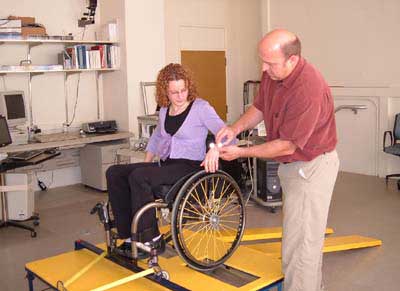
Applicants to the program must be referred by a physician. After receiving the referral information, Tromp van Holst schedules a visit with the patient to assess his or her strength, range of motion, vision, coordination, attention, reaction time, etc. "If there has been any head trauma, I do some cognitive testing," she said.
This evaluation allows her to determine what vehicle and which types of equipment best suit the patient. "There are a lot of equipment choices and every person has different equipment that works for them." she said.
The Driving Rehabilitation Program has a midsize car and a minivan for training, and is hoping to get a full-size van soon. If she determines that a client needs to train in a vehicle the program doesn't have, she may recommend they get equipment installed in their own vehicle, if appropriate, or buy a new or used vehicle from a local dealer. "I meet with the client at the vendor's to make sure the equipment is right," she said. "Then we do a test drive, and go back to the vendor to make changes."
If clients are getting their own vehicles adapted, Tromp van Holst recommends that equipment be installed by a reputable vendor. She cautions against the use of portable hand controls, because they have been known to come loose.
"If someone needs pretty technical, expensive equipment, I usually suggest they get a new vehicle or a used vehicle with low mileage, usually not more than 15,000 miles," she said. Setting up a vehicle with adaptive equipment can range between $800 and $100,000.
Because the UW program specializes in serving people who need a highly technical level of adaptive equipment, "training here is expensive," Tromp van Holst said. Fees are $166 per hour, with a 3-hour minimum. While the cost for someone who is paraplegic may be around $500, someone with a higher level injury may need as many as 8 hours of training.
The cost of disabled driver training may be partially or fully covered by the Washington State Vocational Rehabilitation or Labor and Industries departments, or by public school districts. The Veterans Administration has its own Driving Rehabilitation program for its beneficiaries. Although personal medical insurance doesn't usually cover the cost because it is not considered medically necessary, "I encourage people to bill through their insurance anyway," Tromp van Holst said.
The Driving Rehabilitation Program does not license drivers. This must be done by the State Department of Licensing.
For more information link here for the UW Driving Rehabilitation Program , or call 206-598-5857.
Four vendors were present at the Forum to demonstrate their specially equipped vehicles: Rich's Northwest Mobility (Snohomish, 425-481-6546); Access Mobility Systems (Edmonds, 425-771-4659); Mobility Concepts, Inc. (Fife, 253-896-0970); and Mobility Systems (Sumner, 253-863-4744).
Information about adaptive RV rentals can be found in these publications: Highways ( www.goodsamclub.com ; goodsam@goodsamclub.com ; 805-667-4100) and Trailer Life ( www.trailerlife.com ; 805-667-4100).


